


Platinum and palladium look similar and belong to the same elemental family, yet their prices can move in different directions. End uses, technology choices, substitution, mine geography and recycling determine the balance for each metal.
What are platinum-group metals?
The platinum-group metals include platinum, palladium and several related elements. They are valued for catalytic performance, resistance to corrosion and high-temperature characteristics. These properties support specialised industrial applications.
A shared family name does not create identical markets. Each metal has its own production profile, inventories, end-use mix and investor participation. Product symbols and CFD specifications also differ.
Automotive catalyst demand
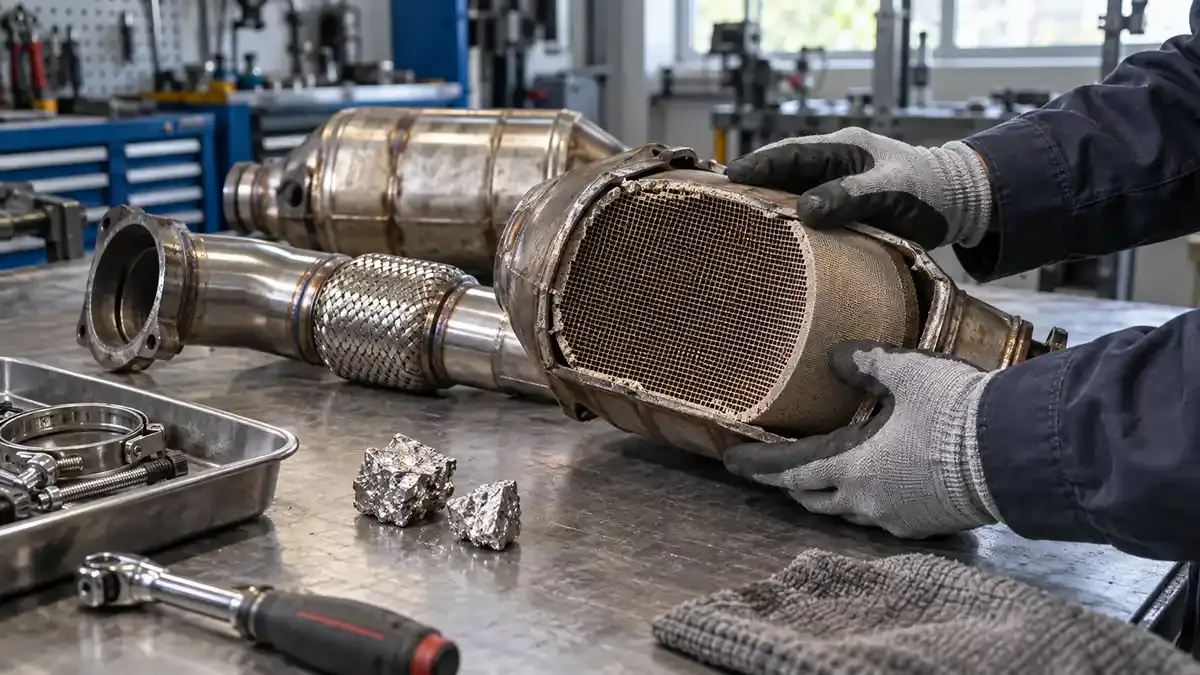
Platinum and palladium are used in emissions-control catalysts that help convert harmful exhaust gases. Demand can therefore respond to vehicle production, the mix of powertrains, emissions standards, catalyst loadings and recycling from end-of-life vehicles.
The effect is not captured by a single vehicle-sales number. Regional regulations, petrol and diesel shares, hybridisation, engineering changes and existing inventories can change metal use per vehicle. Battery-electric adoption can reduce one demand channel while other industrial and energy applications develop.
Substitution between platinum and palladium
When relative prices or availability change, manufacturers may redesign systems to use more of one metal and less of another where performance allows. This can connect the two markets and gradually reshape demand.
Substitution takes time. Engineering, testing, certification, production tooling and supply contracts create friction. A theoretical price advantage does not produce an immediate one-for-one switch, and the feasible ratio varies by application.
Other industrial and investment demand
Platinum has uses across chemical, petroleum, electrical, glass, jewellery and investment markets, with emerging interest around hydrogen-related technologies. Palladium also serves chemical, electronics and other specialist applications.
These categories respond to different cycles. Jewellery demand may react to consumer income and relative price, while industrial projects may depend on capital spending and technical requirements. Investment products can introduce another flow whose timing differs from fabrication.
Concentrated mine supply and recycling
PGM mine production is concentrated in a small number of producing regions. Operational disruptions, power availability, labour relations, currency changes and by-product economics can therefore matter. Much PGM output is produced in polymetallic operations, so the economics of other metals can affect decisions.
Recycling—especially recovered automotive catalyst material—is an important supply source. Collection volumes, processing capacity, metal prices and the age of the vehicle fleet influence the timing. Recycling can cushion a deficit but is not an unlimited or instantaneous response.
A PGM analysis framework
- Demand: Separate automotive, industrial, jewellery and investment channels.
- Technology: Track catalyst loading, powertrain mix and substitution evidence.
- Supply: Review producing regions, mine economics and operational risks.
- Recycling: Consider collection, processing and inventory timing.
- Market structure: Check liquidity, positioning, spreads and the time horizon of the evidence.
A strong industrial story does not guarantee a rising price if supply, inventories or expectations move the other way. For the contract and risk context, see metals CFD foundations and how metals are quoted and sized.