

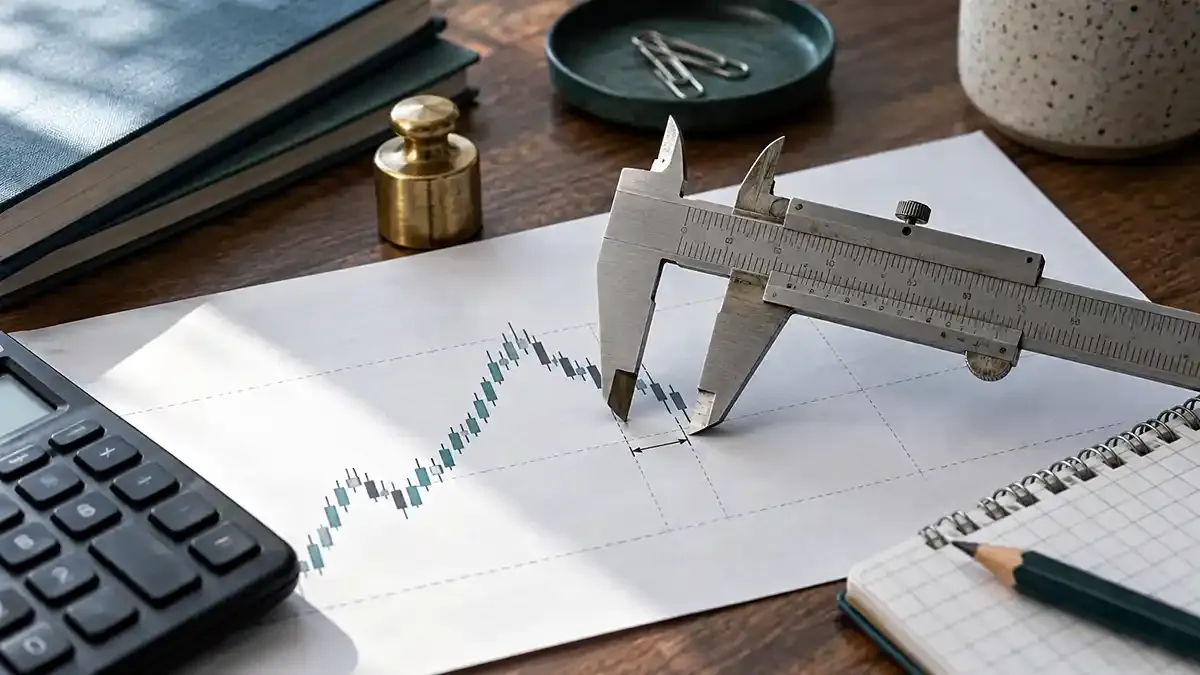

A pip turns a small movement in a currency quote into a standard unit. Pip value then translates that unit into money for a particular position. The two terms are connected, but they are not interchangeable.
Understanding the difference makes it easier to compare pairs, estimate account impact and choose a position size that is not driven by margin availability alone.
What one pip means
For many currency pairs quoted to four conventional decimal places, one pip is 0.0001. A move in EUR/USD from 1.1000 to 1.1001 is one pip. A move from 1.1000 to 1.1050 is 50 pips.
Pairs quoted in Japanese yen commonly use 0.01 as one pip. A move in USD/JPY from 150.00 to 150.01 is one pip, while a move to 150.50 is 50 pips.
Platform points can be smaller than pips
A platform may show EUR/USD to five decimal places or USD/JPY to three. The smallest displayed point is then one tenth of a conventional pip. Fifty platform points would equal five pips in that setup.
Check the symbol’s digits and tick size. Do not assume that every platform use of “point” means one pip.
Calculate the number of pips
For a long position, subtract the opening price from the closing price, then divide by the pip size. For a short position, reverse the subtraction. A positive number is a favourable gross move for that direction; a negative number is adverse.
Example: a long EUR/USD position opens at 1.0820 and closes at 1.0865. The difference is 0.0045. Dividing by 0.0001 gives 45 pips. This is the price movement before costs.
The currency pair anatomy guide explains why rising and falling prices have different meanings for the base and quote currencies.
Turn pips into a currency value
When the quote currency is also the account currency, a simplified pip value is:
position units × pip size = pip value in the quote currency.
For 10,000 units of EUR/USD, 10,000 × 0.0001 equals US$1 per pip. A 45-pip gross move therefore represents US$45 before spread, commission, financing and execution differences.
Yen pairs use a different pip size
For 10,000 units of USD/JPY, 10,000 × 0.01 equals ¥100 per pip. If the account currency is not yen, that amount must be converted at an applicable exchange rate. The account-currency pip value can therefore change as the conversion rate changes.
Lots, contract size and position units
A lot is a platform quantity, while contract size defines how many currency units one lot represents for the symbol. If one lot represents 100,000 base-currency units, 0.10 lot represents 10,000 units and 0.01 lot represents 1,000 units.
These examples are common conventions, not a RockGlobal specification. The actual contract size, minimum volume and volume step must be read from the platform. Our broader guide to lots, contract size and position sizing explains how these fields work across asset classes.
Connect stop distance to account impact
A sizing process can begin with the maximum currency amount a plan permits for the position and the distance to the intended stop. Dividing the amount by the stop distance gives the maximum monetary value per pip before costs.
If the amount is 100 account-currency units and the stop is 50 pips away, the simplified limit is two account-currency units per pip. The position quantity can then be derived from the symbol’s pip value per lot.
Round to a permitted volume step
The calculated quantity may not match the platform’s volume step. Rounding up increases account impact above the calculation. Rounding down is normally the more conservative mechanical adjustment, but the final position still needs to satisfy the plan and product minimum.
Leave room for costs and slippage
A stop distance is not the whole possible loss. The opening spread, commission, overnight financing, conversion and the spread at exit can add cost. A stop order can also fill beyond its trigger during a gap or fast market.
Use a buffer rather than allocating the entire amount to price distance. The guides to total trading cost and liquidity and difficult fills provide the wider context.
Margin is not the risk amount
Margin supports the position; it does not cap its loss. A highly leveraged account may require relatively little margin for a position whose pip value is large compared with account equity.
Calculate price exposure and tolerated account impact first. Then confirm that sufficient margin and free equity remain under the account rules. A margin-based maximum can be much larger than the position supported by a risk-based calculation.
Account currency changes the final pip value
If the quote currency and account currency differ, the quote-currency result must be converted. A EUR/GBP position in a New Zealand-dollar account first creates a pip value in pounds, then converts that value into NZD. Both the pair price and the GBP/NZD conversion rate can affect the final account amount.
MetaTrader may calculate tick values using current conversion quotes supplied for the account. Where separate profit and loss tick values appear, the difference can reflect the bid or ask used for conversion. Use the platform value for the exact symbol and verify it after significant currency movement.
Work through a complete sizing example
Assume a plan allows 120 account-currency units for the position, including an estimated 20 units for spread, commission and possible execution difference. That leaves 100 units for the planned price distance.
If the stop is 40 pips away, the permitted price-movement value is 2.50 units per pip. If the platform shows 10 account-currency units per pip for one lot, the calculated size is 0.25 lot. With a 0.01 volume step, 0.25 is permitted. With a 0.10 step, rounding down to 0.20 would leave more room than rounding up to 0.30.
The example does not predict the eventual loss. A gap can move past the stop, costs can change and conversion rates can move. It demonstrates how the risk amount, cost allowance, stop distance, pip value and volume step fit together.
Recalculate when the inputs change
A saved lot size is not a permanent answer. A different pair, account currency, stop distance, contract specification or conversion rate can change pip value. Deposits and withdrawals can also change the account amount used by a percentage-based plan.
Run the calculation again for each position and after any material account or product change. Confirm the order ticket quantity and estimated margin before submission, then review the actual fill and remaining free margin afterwards.
A practical FX sizing checklist
- Confirm the exact symbol, base currency and quote currency.
- Check digits, pip or tick size, contract size and volume step.
- Set an account-currency amount for the position’s tolerated impact.
- Measure the intended stop distance in pips.
- Calculate pip value in the account currency.
- Round the quantity to a permitted step without exceeding the plan.
- Allow for spread, commission, financing, conversion and slippage.
- Recheck margin and free equity before submitting the order.
The RockGlobal Forex pip lab can help visualise price increments. Its prices and calculations are educational illustrations rather than current quotes or product specifications.